By late November, guided manatee tours at Manatee Park have been on the schedule for about a week. Lee County's own page for the park says something a newcomer might not expect: manatees are not present there from April to early December, and the best viewing comes in late December, January and February. The tours are running and the canal is waiting, and the manatees show up on their own timing.
Their timing follows the temperature of the Gulf, and anyone in Fort Myers can check that reading over coffee before deciding whether a trip out State Road 80 is worth it.
The number to watch is 68, measured at Tarpon Bay
Lee County puts it plainly: manatees are more likely to be at the park when the Gulf cools, and "it is water temperature, not air temperature." The county gives the threshold as 68°F, or 20°C. Below that reading, the warm canal at the park is where they go. The park sits at 10901 State Road 80. The Florida Fish and Wildlife Conservation Commission uses the same line. In its words, "as water temperatures drop below 68 degrees Fahrenheit, Florida's manatees seek refuge at springs, power plant discharge areas and other warm water sites."
The county points to one reading for that temperature: the Tarpon Bay station on the SCCF RECON network. The same county page links the Manatee Park live webcam on Visit Fort Myers, so you can check both the water reading and the canal itself before you get in the car. Lee County also keeps a phone line for viewing conditions at 239-690-5030, ext. 3.
For the warm months, the county points somewhere else: from April to November, manatees are seen in coastal habitat near the Gulf, around Lovers Key.
What the warm water runs on
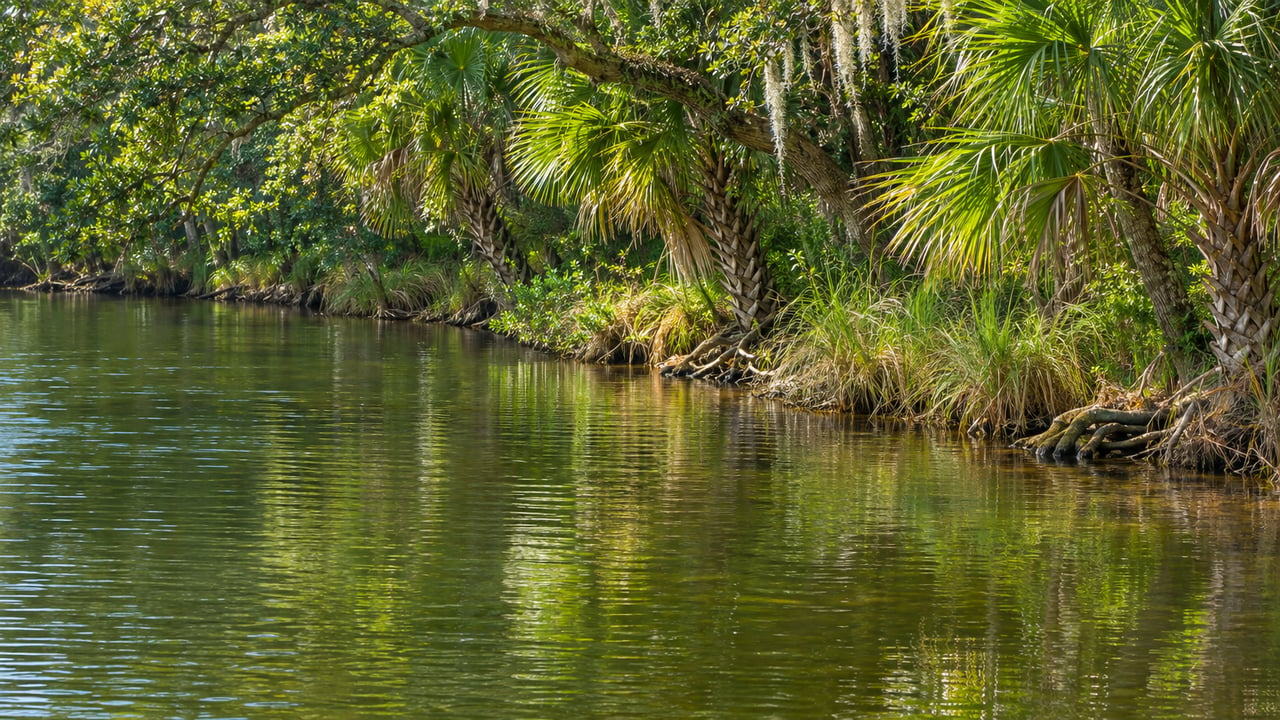
The canal is warm because of the Florida Power & Light plant across State Road 80. Lee County describes that heat as a byproduct of cooling the plant's equipment, and calls the park a non-captive warm-water refuge. The manatees come and go as they please, and they stay because the water is warm. The canal empties into the Orange River, which is why a cold week brings manatees to the park and to the river just beyond it.
Last winter showed how much depends on that warm water. In January, the News-Press photographed manatees gathering at the park during the cold, with kayakers looking for them just outside it. February was harder. WINK News reported, based on state records, that both of the plant's steam turbines went offline in an unplanned outage on February 6. Backup boilers began sending 78-degree water to the canal on February 11, heat fully returned to the canal late on February 17, and the plant was back to full operation on February 19.
FWC's account appeared in WGCU's report of February 25. The agency said the plant complied with its license and its manatee protection plan during what it called a historic cold-weather event. It also said FPL "has agreed to go beyond its license terms to mitigate the impacts of future cold-weather events at this and other industrial sites across the state." In the same report, WGCU counted 58 manatee deaths in Lee County from January 1 through February 25, 2026. Twelve were verified as cold stress. For comparison, the same window in 2025 had 49 deaths. WINK also reported that Lee County delayed the park's opening one morning that month while crews worked in the water. A later WINK story said the park had since reopened.
For a visitor, this comes down to something practical. The coldest weeks bring the most manatees into the canal, and those are also the weeks when the park and its staff are busiest. If you spot a manatee that looks injured or in distress, FWC's Wildlife Alert Hotline is 888-404-FWCC (3922).
The people in the water who aren't paddling
On a winter visit you may see people in or around the lagoon with clipboards, cameras or long poles. Lee County says these are certified biologists working with FWC. Some photograph manatees so they can be identified later by their scar patterns. Others check on an animal that looks hurt, and FWC may come to the park to rescue it. Some take skin samples with a long PVC pipe tipped with a needle. The county notes the sampling may briefly startle a manatee but doesn't injure it, and the samples help scientists study survival, migration and population structure. The canal that draws a crowd on a January weekend is also a working research site, and a cold-week visit often puts that work in plain view from the walkway.
Paddling the Orange River just outside the canal
The Orange River outside the canal is where kayakers go looking for manatees, and the park is set up for it. Lee County lists a self-launch spot for paddlecraft, and Manatee Kayaking Company runs the rentals and gift shop on site at 239-913-9993. On its website, the company lists rentals at $26 for a single kayak and $52 for a double for up to two hours, or $35 and $65 for up to three hours, seven days a week.
The guided option fits a winter that starts slowly. The company's guided manatee tours run from mid-November through March, leaving at 8:30 a.m., 11 a.m. and 1:45 p.m. Each lasts two hours and takes groups of up to 14. Tickets are $65 for ages 13 and up and $45 for children 12 and under. A late-November tour gets you on the river and the wildlife along it, and a tour after a stretch of cold weather in January is the one most likely to find manatees in numbers.
For anyone staying on land, FWC's page on where to see manatees suggests bringing binoculars or a camera with a zoom lens.
Parking, hours and what stays home
Parking is $2 an hour or $5 a day. A shuttle van is $10 and a tour bus is $20 per visit. The Lee County Parks & Recreation annual parking pass is valid here, which helps if your winter plan includes a few weekday mornings after cold fronts.
The park is open seven days a week from 7 a.m. to dusk. The kayak counter keeps shorter hours, 8 a.m. to 5 p.m. from November to April, so an early paddle depends on that window. The 239-690-5030, ext. 3 line is the quickest way to confirm conditions for a particular morning.
Some things stay home. Dogs aren't allowed except service animals, and the county keeps a list of dog parks for that part of the week. Bikes aren't allowed in the park either, though a bike rack sits by the entrance. If you were hoping to host a gathering under a pavilion while the canal is full, the timing won't work. The pavilion, shelter, amphitheater, chickee hut and picnic area can be rented April through November, and winter rentals from December through March aren't offered.
The rest of the park stays open whether the manatees have arrived or not. There's a butterfly garden, a walking path, playgrounds, picnic areas and volunteer interpretive naturalists. Lee County arranges group tours and programs on request at 239-533-7523, and the park takes volunteers. A November walk through the butterfly garden is a fine way to get to know the park before the canal starts to fill.
At The Fowler Team, we think the best Fort Myers winters are the ones you plan around the small local details, like a water reading at Tarpon Bay or an 8:30 a.m. paddle after a cold front. If you're thinking about a home where mornings on the Orange River are a short drive away, our Fort Myers neighborhood guide is a good place to start, and we're always happy to talk about which parts of town put Manatee Park within easy reach. Discover Your SWFL Home.