The 2026 housing market was finally starting to gain momentum. Mortgage rates had dipped below 6% for the first time in years, buyer confidence was improving, and many in real estate expected a stronger spring season.
Then geopolitical uncertainty changed the conversation.
The ongoing conflict involving Iran has quickly become one of the biggest economic storylines affecting real estate today — not because buyers are suddenly focused on foreign policy, but because of what the conflict is doing to inflation, oil prices, mortgage rates, and consumer confidence.
Why Global Conflict Matters to Housing
At first glance, a conflict overseas may seem disconnected from local real estate markets in places like Florida or across the U.S. But housing reacts heavily to economic sentiment and borrowing costs.
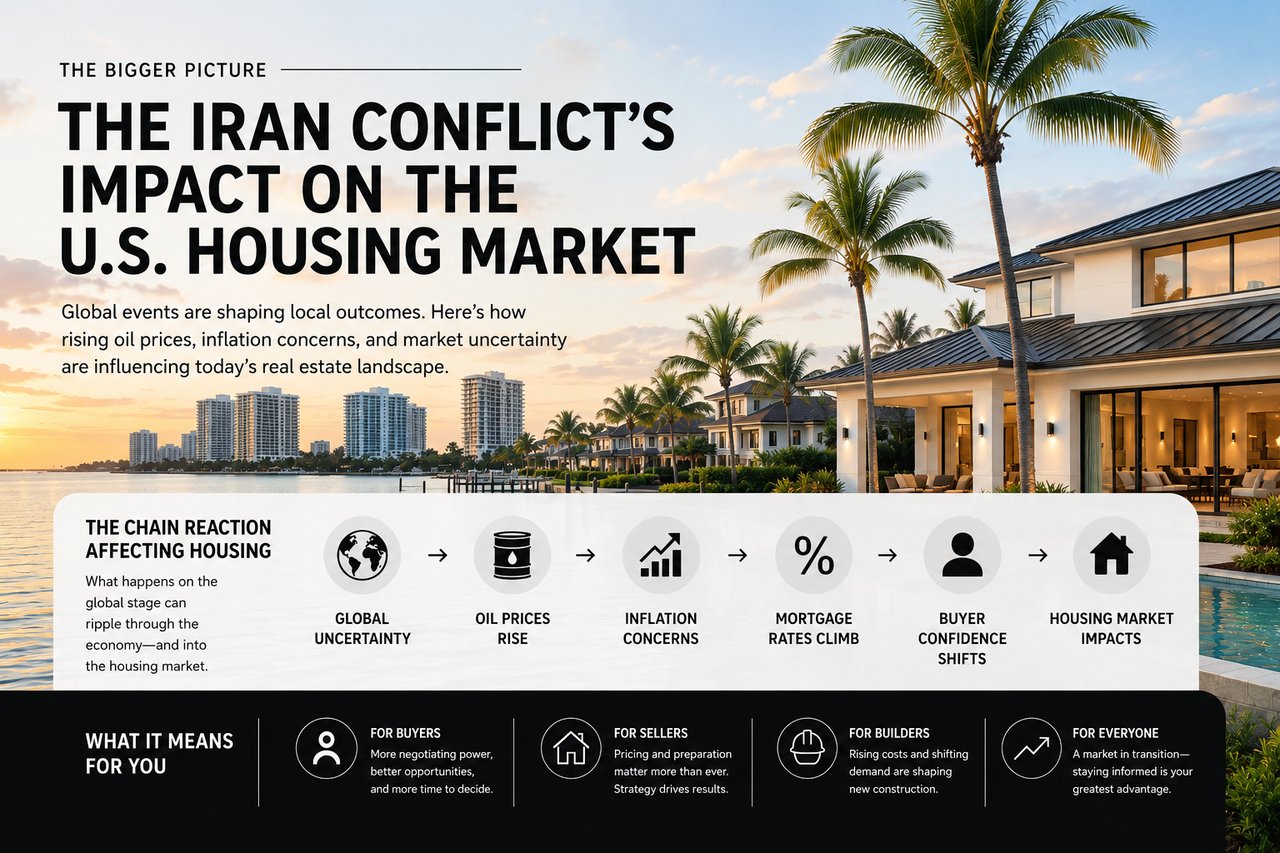
Here’s the chain reaction happening right now:
- Conflict creates uncertainty in financial markets
- Oil and energy prices rise
- Inflation concerns increase
- Treasury yields climb
- Mortgage rates move higher
- Buyer affordability weakens
That sequence has already started to play out.
According to recent housing and economic reports, mortgage rates moved from under 6% earlier this year to the mid-6% range following the escalation of the Iran conflict.
For buyers, even a small jump in rates can dramatically change monthly affordability.
The Biggest Impact: Mortgage Rates
Mortgage rates remain the single most important factor in today’s housing market.
When rates briefly dropped below 6%, many buyers who had been sitting on the sidelines started re-engaging. But the recent spike has once again slowed momentum. Existing home sales recently fell to a nine-month low as affordability pressures returned.
For perspective:
M=Pr(1+r)n(1+r)n−1M = P\frac{r(1+r)^n}{(1+r)^n-1}
Even a 0.5% increase in mortgage rates can add hundreds of dollars per month to a buyer’s payment depending on price point and financing structure.
That matters significantly in higher-priced or lifestyle-driven markets where many buyers are already stretching budgets due to insurance, taxes, HOA fees, and rising ownership costs.
Buyer Psychology Has Shifted Again
The housing market in 2026 was already operating in a more cautious environment. Inventory has been improving in many areas, and buyers have become increasingly selective.
Now, uncertainty surrounding inflation and the economy is making some buyers pause decisions entirely.
Recent industry surveys showed that consumers are becoming more hesitant as gas prices rise and economic headlines dominate the news cycle.
That does not mean the market is collapsing.
It means buyers are:
- Taking longer to make decisions
- Negotiating more aggressively
- Comparing resale vs. new construction more carefully
- Prioritizing value and monthly payment over emotion
In many ways, this is less of a “crash” environment and more of a “normalization” environment.
New Construction Is Feeling Pressure Too
Builders are also dealing with the ripple effects of rising fuel and material costs.
Construction sentiment recently dropped to a seven-month low as builders cited higher operating costs, labor challenges, and affordability concerns.
Fuel prices impact nearly every stage of construction:
- Transportation of materials
- Manufacturing costs
- Equipment operation
- Labor expenses
Some builders are responding by:
- Offering larger incentives
- Covering closing costs
- Discounting inventory homes
- Slowing future spec inventory
In markets across Florida, this has created a more competitive landscape between resale homes and builder inventory.
What This Means for Sellers
Today’s market rewards strategy more than ever.
Homes that are:
- Properly priced
- Well-presented
- Updated
- Move-in ready
- Marketed aggressively
…are still selling.
But overpriced listings or homes competing directly against discounted new construction are sitting longer.
The reality is that buyers today are analyzing value much more carefully than they were during the ultra-low-rate years.
What This Means for Buyers
Ironically, uncertainty can also create opportunity.
As competition cools and inventory grows, buyers often gain:
- More negotiating leverage
- Better pricing opportunities
- More time to evaluate homes
- Stronger builder incentives
For buyers with stable finances and long-term plans, this environment can actually present better opportunities than the highly competitive markets of previous years.
The Bottom Line
The Iran conflict is not directly “causing” a housing downturn. But it is influencing the economic variables that matter most to real estate — particularly inflation, energy prices, and mortgage rates.
The result is a housing market that has become:
- More cautious
- More strategic
- More payment-sensitive
- More dependent on pricing accuracy
Real estate is still moving. Buyers are still buying. Sellers are still selling.
But in 2026, success is increasingly going to the people who understand the market has shifted from frenzy to strategy.